by Sebastien GOULARD
As the United Kingdom considers closer ties with the European Union, potentially going as far as rejoining the bloc, Greek Prime Minister Kyriakos Mitsotakis has stated that the question of returning the Parthenon Marbles, currently on display at the British Museum, to Greece should be included in negotiations on the United Kingdom’s possible re-admission to the EU.
A Centuries-Old Dispute
In late September, British Prime Minister Andy Burnham stated that his country’s return to the European Union (a “Breturn”) was an option worth considering when it came to the future of relations between London and Brussels. Although a referendum on the issue is not currently on the agenda, the Labour Party could include one in a future manifesto. The announcement was enthusiastically welcomed by several European leaders, including French President Emmanuel Macron and Spanish Prime Minister Pedro Sánchez, who encouraged the British people to seize this opportunity. However, according to the Greek Prime Minister, the United Kingdom must first return the Parthenon Marbles.
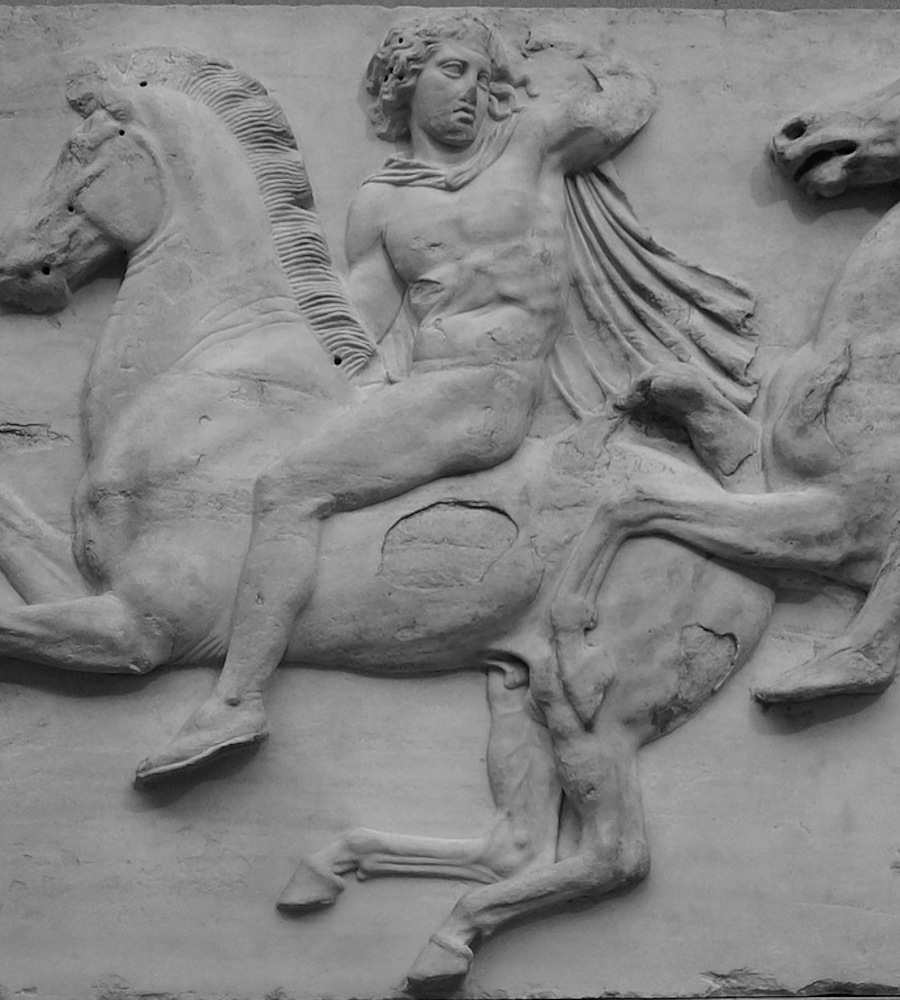
This is not the first time Greece has called for their return: the issue has poisoned relations between Athens and London for two centuries. In 1801, the British ambassador to Constantinople, Lord Elgin, took possession of the Parthenon Marbles under the pretext of gaining a better understanding of ancient Greek civilisation. However, as early as 1832, following Greece’s independence, the newly established kingdom sought to buy these works back from Great Britain, but to no avail.
In England, too, voices were raised in condemnation of this act of plunder. As early as 1812, Lord Byron described Lord Elgin as a vandal.
The Acropolis Museum, which opened in 2009, was designed to house the Parthenon Marbles, and Athens continues to insist that these works be returned. In 2022, negotiations between London and Athens were revived in an attempt to resolve the diplomatic dispute, but statements from both sides brought the dialogue to an end. From London’s perspective, these sculptures, which have been on display since 1802, have now become part of Britain’s national heritage, a position Greece naturally contests.
A Threat to the Breturn
Although British public opinion appears increasingly favourable to rejoining the European Union, with 50% supporting the proposal compared with 28% opposed, British political leaders remain divided on the issue. Several prominent Labour Party figures, including members of Andy Burnham’s government, have expressed strong reservations about this option. In September 2026, Lucy Powell, the Labour Party’s deputy leader, stated that the United Kingdom’s return to the European Union was “neither possible nor desirable”.
Conditioning the United Kingdom’s re-admission to the European Union on the return of the Parthenon Marbles to Greece could only increase opposition to the proposal among the British public and strengthen anti-European parties such as Reform UK. Such a condition would rightly be perceived as blackmail and would portray the United Kingdom as weak. There is little doubt that Brexit supporters would play on the British people’s nationalistic sentiments, presenting the condition as a sign of London’s diminished standing in relation to Brussels and Athens.
If the presence of the Parthenon Marbles at the British Museum is regarded as a humiliation for the Greek people, the obligation to return them to Greece as part of European negotiations would be perceived as another humiliation, this time for the British people.
Setting a Precedent
Furthermore, the condition put forward by Athens could set a precedent, encouraging other European states to join the Greek initiative and demand the return of other works of art. Italy, for instance, could support the Greek claim. The British Museum houses works originating from numerous European countries, some of which may have been acquired under questionable circumstances in past centuries. It is entirely legitimate for European states to consider whether these works should be returned.
The British Museum is already working with African governments and institutions on the restitution or long-term loan of works previously held in London. If a similar discussion is to take place regarding the Parthenon Marbles, however, it should not be conducted within the framework of a possible British return to the European Union, as this could antagonise all parties involved. The “Breturn” issue is already complicated enough without adding another layer of difficulty.
Nevertheless, one can understand why, for Greek Prime Minister Kyriakos Mitsotakis, the return of the Parthenon Marbles would represent more than a political victory. It would also offer him the opportunity to go down in history as the man who avenged this affront.
Reviving Negotiations
Rather than resorting to direct confrontation linked to the United Kingdom’s reintegration into the European Union, it would be preferable for European states to strengthen their cultural cooperation policies in order to facilitate the restitution and loan of artworks between museums, in a calmer atmosphere, free from political controversy and partisan manoeuvring.
It is also to be hoped that negotiations between London and Athens will resume in good faith, within a more constructive and conciliatory climate.

Sebastien GOULARD
Sebastien Goulard is a consultant at Cooperans, a consultancy specializing in international relations.
He is also the founder of Diplomarty.
Sebastien Goulard holds a doctorate in economic and social development from Ecole des Hautes Etudes en Sciences Sociales (School for Advanced Studies in the Social Sciences), Paris. He has been involved in several European research programs focusing on sustainable urbanization in China.