by Sebastien GOULARD
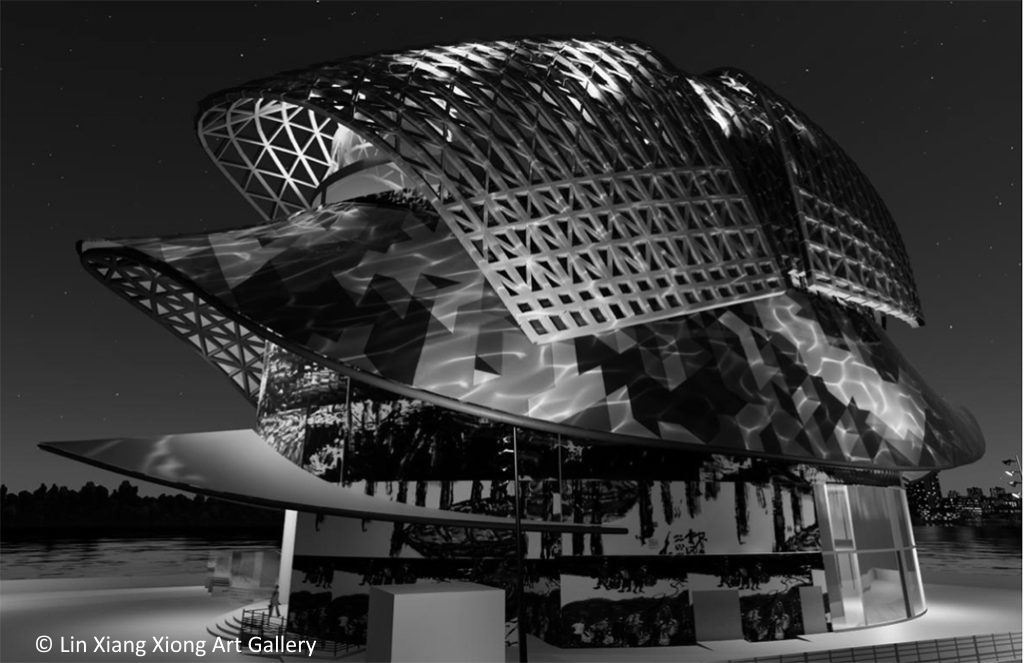
Malaysia has welcomed a new museum since mid-December 2025. The Lin Xiang Xiong Art Gallery has opened its doors on the island of Penang and contributes to Malaysia’s international image.
A New Artistic Hub
This new complex, featuring bold waterfront architecture, includes an art gallery, a convention center, and an educational center. With nearly 8,000 square meters of space spread over seven floors, the Lin Xiang Xiong Gallery has become a landmark of Penang’s landscape and contributes to the island’s growing reputation. The project is a private initiative launched by businessman and artist Lin Xiang Xiong, born in 1945. A Singaporean citizen of Chinese origin (from Guangdong Province), he built his fortune in Malaysia’s mining sector. However, after studying fine arts in his youth, he continued throughout his career to paint in a style that blends classical and contemporary techniques. His passion for art led Lin Xiang Xiong to collaborate with artists from around the world, and in 2016 he became curator of an exhibition for Peace organized by UNESCO.
Art for Peace
For Lin Xiang Xiong, artists are artisans of peace. In line with this vision, he also launched a Peace Prize that annually rewards an artist working toward greater global understanding. The prize includes a financial award as well as the opportunity to exhibit at the new Malaysian museum.
The museum displays works by Lin Xiang Xiong that explore themes of peace, nature, and the history of Southeast Asia. The choice of Penang Island is no coincidence. Even before it was acquired by the British East India Company in 1786, the island already served as a crossroads for Arab, Chinese, Indian, and Malay traders, and it has retained Asian and Western influences in its architecture and way of life. Through its collections, the new Lin Xiang Xiong Gallery reconnects with local traditions while fostering new exchanges among artists from around the world.
Tourism in Malaysia
This initiative comes at an opportune time for Malaysia, which aims to confirm its status as a rising destination in Southeast Asia. In 2025, the country welcomed nearly 31 million foreign visitors, an increase of 15% compared to the previous year, and hopes to attract more than 35 million in 2026 through its “Visit Malaysia 2026” campaign. Today, one third of foreign visitors to Malaysia come from neighboring countries, primarily Singapore, as well as Brunei and Thailand. Chinese tourists accounted for 13% of foreign visitors in 2024, yet represented 20% of tourism-generated revenue due to their higher spending levels. The current geopolitical context in Southeast Asia, particularly tensions between Cambodia and Thailand, as well as maritime disputes between the Philippines and China, makes Malaysia, thanks to its political stability, especially attractive to foreign tourists, notably Chinese visitors. In 2026, 21 new air routes will connect Malaysia’s airports to the rest of the world.
The country has much to offer in terms of landscapes, activities, gastronomy, and culture. However, prior to the opening of the Lin Xiang Xiong Gallery, Malaysia’s contemporary art offering was more limited. Today, this new museum diversifies and enhances the country’s tourism appeal and is expected to become a symbol of Penang, much like the Guggenheim Museum is for Bilbao. The capital of Penang Island, George Town, already attracts tourists from around the world thanks to its well-preserved heritage that blends Asian and European elements; its historic center is listed as a UNESCO World Heritage Site. This new museum is therefore expected to further enrich the already extensive cultural offering of Penang Island.
Beyond tourism, the new Penang museum illustrates Malaysia’s ambition to play a greater role on the international stage and to position itself as a bridge between East and West. The opening of the Lin Xiang Xiong Gallery also reflects Malaysia’s efforts to maintain a neutral stance between major powers such as China and the United States. While Malaysia seeks to assert itself internationally and may join the BRICS, it does not wish to align itself with other powers in order to preserve its freedom of action and maintain the stability that defines it. Strengthening its cultural and artistic soft power is a key element of its regional and international outreach strategy.
Sebastien GOULARD
Sebastien Goulard is a consultant at Cooperans, a consultancy specializing in international relations.
He is also the founder of Diplomarty.
Sebastien Goulard holds a doctorate in economic and social development from Ecole des Hautes Etudes en Sciences Sociales (School for Advanced Studies in the Social Sciences), Paris. He has been involved in several European research programs focusing on sustainable urbanization in China.